

Mastering GEO: The Non-Profit Guide to AI Search
Generative Engine Optimization (GEO) is the strategic process of preparing your non-profit’s digital content to be selected, synthesized, and cited by AI engines like ChatGPT, Claude, and Google AI. By focusing on authoritative citations, structured data, and context-rich content, GEO ensures your mission appears as the primary answer to donor and beneficiary queries.
What is Generative Engine Optimization (GEO) for Non-Profits?
For years, non-profit leaders have focused on Search Engine Optimization (SEO). The goal was simple: rank on the first page of Google. But the world has shifted. Today, people aren’t just looking for a list of links; they are asking AI for direct answers. They ask, "Which local non-profit in Seattle has the highest impact on food insecurity?" or "How can I donate my car to a veteran charity safely?"
GEO is the next evolution. It is about becoming the "source of truth" for Large Language Models (LLMs). When an AI model processes a request, it scans its training data and real-time web results to formulate a response. If your website is structured correctly, the AI won't just know you exist—it will quote you as the authority. This is critical for organizations using managed website services for nonprofits because visibility now depends on being machine-readable and highly authoritative.
Traditional SEO focused on keywords like "charity donations." GEO focuses on semantic meaning. It asks: does this content provide enough data for an AI to understand the impact and credibility of the organization? For non-profit leaders, this shift means moving away from thin content and moving toward deep, data-backed storytelling that AI agents can easily digest and present to potential donors.
How do AI engines like ChatGPT and Claude find your mission?
Unlike traditional search engines that index pages based on backlinks and keywords, AI models like ChatGPT and Claude look for patterns, context, and citations. They prioritize information that appears to be well-supported by multiple sources. For a non-profit, this means your "brand mention" across the web is just as important as your own website's content.
When a user asks Claude for a recommendation, the model looks for specific identifiers:
- Citations and References: Does your mission appear in reputable news articles, government databases, or academic papers?
- Unstructured Data Consistency: Is your story consistent across your blog, social media, and third-party review sites?
- Expertise and Authoritativeness: Do you provide deep-dive reports, white papers, or impact data that demonstrate a high level of expertise in your field?
- Entity Recognition: Does the AI recognize your non-profit as a specific "entity" with a defined purpose, location, and leadership team?
Building this authority requires a shift in how you produce content. Instead of short, generic updates, your blog should focus on becoming a resource. For instance, using strategic web design services helps create a site architecture that highlights these authoritative elements. If you are an environmental non-profit, don't just say "we plant trees." Provide a 3,000-word guide on the native species of your region and the specific CO2 impact of your projects. That depth is what an AI engine craves.
Why does your non-profit need deep data for better AI rankings?
AI engines are essentially "pattern matchers." They are looking for the most complete answer to a user's question. If your website only offers surface-level information, the AI will likely skip over you in favor of a site that provides hard numbers, specific locations, and historical context.
Deep data includes everything from your annual impact reports to specific case studies. For example, if you are working on local search engine optimization , you shouldn't just list your address. You should provide structured data about the specific neighborhoods you serve, the number of volunteers in each area, and the local partners you collaborate with. This granular detail helps AI models connect your non-profit to very specific user queries, such as "What are the most active youth mentorship programs in Oakland?"
How does Duda automate your technical AI readiness?
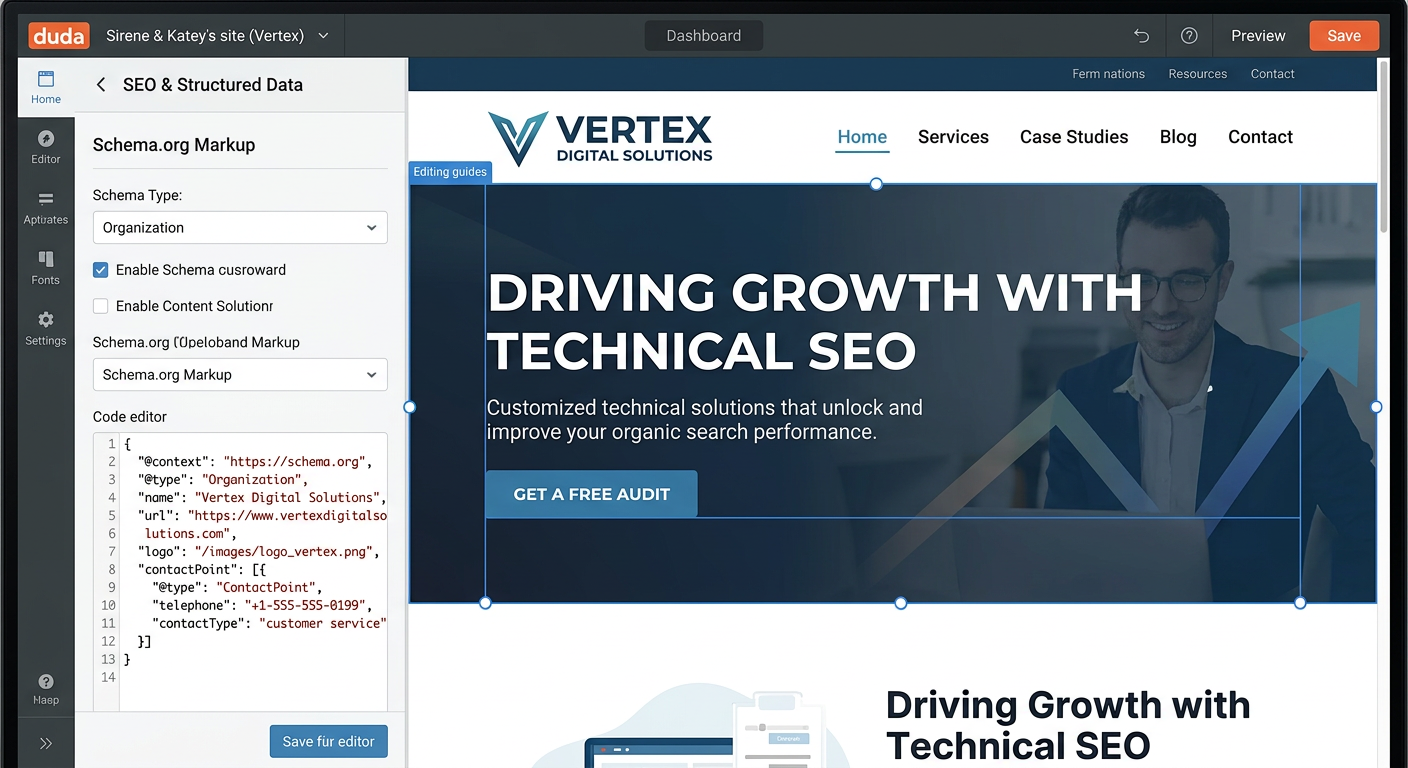
One of the biggest hurdles in GEO is the technical side: Schema markup, JSON-LD, and Core Web Vitals. These are the "invisible" parts of your website that talk directly to AI crawlers. Many non-profit leaders find this overwhelming, but this is where the right platform makes all the difference. Duda is specifically designed to handle these technical requirements out of the box, which is why we recommend it for web design in the AI era.
AI models prioritize speed and accessibility. If a crawler cannot quickly access your data, or if your site isn't website accessibility compliant, it may be downgraded in the AI's internal ranking of "reliable sources." Duda automates several key components:
- Automated Schema Markup: It creates the structured data code that tells AI exactly what your organization does, who your leaders are, and where you are located.
- Lightning-Fast Loading: Speed is a signal of quality. Duda's architecture ensures that AI crawlers can index your site efficiently.
- Mobile Optimization: Many AI searches happen on mobile devices; Duda ensures your content is perfectly formatted for every screen.
- Security and Uptime: A site that is frequently down or insecure is a red flag for generative engines.
By automating these technical foundations, non-profit leaders can stop worrying about the "pipes" and start focusing on the "water"—their mission-driven content. When your technical foundation is handled, your path to becoming a primary answer is much clearer.
Winning the Google AI Overviews Race
Google's AI Overviews (formerly SGE) represent a massive shift in the SERP (Search Engine Results Page). Instead of ten blue links, Google now provides a synthesized summary at the top of the page. To appear in this summary, your content needs to be highly relevant to the searcher's intent.
Google's AI looks for "information gain." It wants to see something new or more detailed than what is already available. For non-profits, this means you must avoid generic language. Use unique imagery, original research, and first-hand accounts of your work. This creates a "moat" around your content that AI models cannot easily replicate, making you the preferred choice for their summary snippets.
Your Roadmap to Becoming the Primary AI Answer
The transition from SEO to GEO isn't something that happens overnight, but it is the most important digital shift for non-profits in the last decade. Staying invisible in AI search means losing out on the next generation of donors who use these tools as their primary source of information. By focusing on authority, deep data, and technical readiness, you can ensure your mission is heard.
To master the AI shift, focus on these five steps:
- Audit your existing content for "thinness" and replace it with data-backed, long-form resources.
- Implement comprehensive schema markup using a platform like Duda to ensure your data is machine-readable.
- Build a citation network by securing mentions on authoritative third-party sites and news outlets.
- Prioritize user intent by turning your H2 headings into the natural-language questions your donors are actually asking.
- Optimize for speed and accessibility to prove to AI engines that your site is a reliable and high-quality destination.
At EnlightWorks, we specialize in helping organizations navigate these changes through our managed website services for nonprofits . The goal is no longer just to be on the web; it is to be the answer that the world’s most powerful AI engines provide when someone looks for a way to make a difference. Don't let your mission be left behind in the archives of the traditional web. It is time to step into the future of search.
If you're ready to modernize your digital presence, start with a website planner or reach out for a quote request today. The shift to GEO is an opportunity to amplify your impact like never before.