


Local SEO for Small to Medium Businesses: How to Stand Out in Your Area

Trisha Matta • June 11, 2025

In today’s world, where most customers search online before ever stepping foot in a store or sending an inquiry, showing up in local search results is a must—especially for small businesses trying to get discovered in their neighborhood.


Whether you're a local café, or a service-based business like a salon, consultancy, or HVAC contractor, your local customers are looking for you nearby. And if you’re not showing up, your competitors likely are.


This is where local Search Engine Optimization (SEO) comes in. Besides showing up on Google, it’s about being in the right place, at the right time, for the right potential customers.


At EnlightWorks, we help small to medium businesses like yours use local SEO to build local visibility, drive leads, and actually compete, even without a massive marketing budget. Here’s how we do it, and how you can too.

A group of people are sitting around a table in a living room.

The Importance Of Local SEO

Local SEO is the process of optimizing your online presence to attract more business from relevant local searches. These searches happen on Google and other search engines, but Google dominates the field, especially through Google Business Profiles (formerly Google My Business).


For example, if someone searches for “bakery near me” or “tattoo artist in New York,” or even as simple as "local restaurants", local SEO determines whether your business shows up, or if you're buried on page 3, behind bigger brands.

So if you’re:


  • A small shop looking to attract more foot traffic
  • A service provider working with clients in specific areas
  • An independent business trying to stand out next to chains or franchises


… having a good local SEO strategy will be your most powerful (and cost-effective) tool. It should be integrated into your overall marketing strategy.


How can you execute this? Here are some of the best ways.

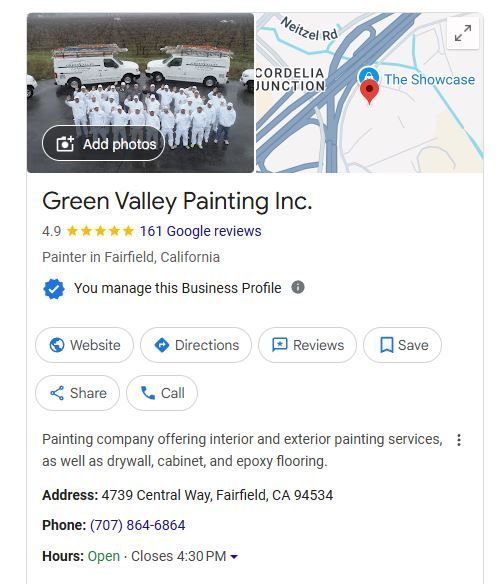
Green Valley Painting inc. is a painting company offering interior and exterior painting services

Nail Your GBP (Google Business Profile).

Your Google Business Profile is essentially your digital storefront. It’s what shows up in the “map pack” (those top three listings that appear below the map on Google) and gives searchers key info at a glance: business information, location, hours, reviews, online reviews, photos, and more.


What you can do:


  • Claim and verify your profile if you haven’t already.
  • Use your exact business name, do not do keyword stuffing here.
  • List accurate NAP (Name, Address, Phone) details. These should match your website and other business listings.
  • Add your services and local service area.
  • Upload real, high-quality photos of your team, office, and work.
  • Write a solid business description that tells people who you are and what makes you different. Make sure to include relevant information and relevant keywords.
  • Follow Google Business Profile Help recommendations.


A map of a city with red pins on it.

Build (Real) Local Backlinks

Think of this as online word-of-mouth. When other local websites mention or link to you, Google sees you as more legit.

Get local backlinks by:


  • Partnering with other small businesses or community groups
  • Being featured in neighborhood blogs or directories
  • Writing for local publications or guides
  • Getting mentioned in case studies, roundups, or PR stories


This kind of local link building helps show you’re part of the local community.

A woman is sitting at a table with a laptop and a cell phone.

Collect Reviews 

Small businesses thrive on positive reviews. They're one of the top local SEO ranking factors and help with both visibility and conversion.


  • Ask your happy customers (gently!) to leave a review
  • Send a follow-up email with the Google review link
  • Respond to every review. Yes, even the negative reviews


It’s social proof, and it shows you care. Plus, it helps Google understand your reputation.

Optimize for Mobile and Speed

Most of your local customers will check you out from their phone—right before they decide whether or not to visit or buy.


Check that:


  • Your site is easy to navigate on mobile
  • Buttons are clickable and phone numbers are tap-to-call
  • It loads quickly (ideally in under 3 seconds)
  • Key info like location and hours are front and center


Use Google Analytics, Google Search Console, or other free tools to fix what’s slowing things down.

A red pin on a map with people walking in the background.

Prioritize Local Content

Don’t just talk about your product, talk about your place. What’s happening in your area? What do local customers care about?

Create content like:


  • Dedicated landing pages for specific locations
  • Blogs or videos about events or community topics
  • FAQs specific to your city or product use in your area
  • Case studies or customer stories from nearby


This builds local visibility, creates connection, and shows Google your site is active and relevant.

The bottom Line: Always show up where to matters most

If you’re a small or medium-sized business trying to compete locally, local SEO is one of the highest-ROI investments you can make. It brings qualified leads to you, without you having to chase them. 

Ready to be the business people find first? 

Most small to medium businesses can rank well locally. You don’t need a massive marketing plan or a national campaign, you need strategy, consistency, and a team that knows how to make your website work harder for you.


That’s what we do best here at EnlightWorks. We build and manage websites that do more than look good, they generate actual results. From strategy, local SEO and conversion optimization to ongoing support and updates, we’re here to help your business’s website show up when it matters most.


A professional working at a desk in a bright, open-concept office, focusing on a computer screen.
By EnlightWorks March 24, 2026
A comprehensive guide for non-profit leaders to transition from SEO to GEO (Generative Engine Optimization), ensuring their mission is found on ChatGPT, Claude, and Google AI.

A digital visualization of AI search engine optimization concepts.
March 19, 2026
Learn how to transition from traditional SEO to AI search optimization. Discover how to find AI-friendly topics and structure content for LLMs to gain visibility.

March 4, 2026
If you run a B2B business, your website should be your hardest-working salesperson. But for most companies, it’s not. You invest in a good-looking site, publish some content, and hope the leads come in. But they rarely do.  The reason is simple: most B2B websites are designed to look good , not to generate leads . Here are the most common problems we see: Unclear messaging: Visitors can’t tell what you do or how you help them within a few seconds of landing on your site. Poor alignment with the buying journey: B2B sales involve multiple decision-makers. Most sites don’t support this layered process. Weak calls to action: Forms are hidden, contact buttons are vague, and there’s no clear next step for the visitor. No search strategy: Your website might look professional, but if it’s not optimized for how your buyers search online, you won’t get the right traffic. No ongoing management: Websites that sit untouched quickly become outdated. B2B buyer behavior and search algorithms change constantly, and your site should evolve too.
March 4, 2026
For years, business owners have asked the same question: “Do I still need a website, or can I get by with just social media or a Google Business Profile?” In 2026, with the rise of AI-generated content, short-form social platforms, and new customer discovery tools, the question comes up even more often. But the answer hasn’t changed. Yes. You absolutely still need a website in 2026 and beyond. In fact, a professionally managed website from a provider like EnlightWorks is more essential than ever before.
March 4, 2026
Your website is a living, working asset that directly impacts your brand, conversions, and bottom line. When it is built right, optimized consistently, and managed with data-driven care, it becomes one of the most powerful investments a business can make.
March 4, 2026
If you run a Managed Service Provider (MSP) business, you’ve probably asked yourself: “Do MSPs Still Need SEO in 2026?” With AI, voice search, search engines shifting to direct answers, and new ways people consume information, some wonder if traditional search engine optimization is still worth the investment. The short answer? Absolutely, yes. SEO is not dead, but evolving. But the approach MSPs take in 2026 needs to be sharper, more strategic, and aligned with how your potential clients actually research and choose managed IT services. Let's tackle what has changed, why SEO is still essential, and how to build an MSP SEO strategy that fuels business growth, qualified leads, increases website traffic, and brand awareness in today’s landscape.
March 2, 2026
On paper, an MSP looks like any other local service business. You serve a city. You have a phone number. You want to rank on Google. But in practice, EnlightWorks MSP SEO works very differently from how SEO works for plumbers, dentists, or even other B2B service firms. If you try to run an MSP website like a generic local business, it usually stalls. Traffic stays low. Leads stay inconsistent. And the companies that do win online seem to do it without playing by the usual rules. That is not an accident. Managed IT services sit in a unique position between high trust, high risk, and long buying cycles, and that changes how search engines and buyers behave.
March 2, 2026
Search Engine Optimization (SEO) is far from just your typical keyword integrations now. If you speak with most managed service providers about SEO, you will hear the same story. They’ve invested in blogs. They’ve hired agencies. They rank for a few keywords. And yet… the phone is still quiet. There are still no leads. For MSPs in 2026, SEO is a mix of strategic content, technical excellence, and alignment with modern search behavior (including generative AI and intent-driven discovery). Search visibility is no longer about being found online. It is about being the most credible answer to a specific business problem at the exact moment someone is looking for help . If your MSP wants consistent inbound leads, long-term growth, and a sustainable competitive edge, understanding the new SEO landscape is non-negotiable . You’re not selling t-shirts or consumer products. You’re selling trust, security, and long-term operational stability. The buying cycle is longer. The stakes are higher. And the people searching are business owners or IT leaders who want clarity, not marketing. In this guide, we’ll cover: What’s changed in SEO for MSPs What MSPs need to stay ahead of the game An outlook for 2026 and beyond Your best SEO partner throughout all of these
February 28, 2026
If you run an MSP, you already know the competition is tough. You are not just competing with the provider down the street anymore. You are competing with every other MSP that shows up when a business owner types “IT support near me” into Google. And in 2026, the fight for visibility online is more competitive than ever. Here’s what the landscape looks like right now and how you can break through it.
February 28, 2026
If you run a church, NGO, or community group, you’ve likely asked yourself: “How do we reach more people without spending money we don’t have?” The answer, increasingly, is SEO . Search Engine Optimization is often seen as technical, expensive, or “something only businesses need.” But the reality is that SEO is about being found when people need you most. And for faith communities, nonprofits, and grassroots groups, that is part of the mission. EnlightWorks believes that websites for mission-driven organisations should do more than sit online. They should connect, inspire, and mobilise. Here’s a clear, evidence-based guide on what actually works.
Show More