

SEO for Churches, NGOs, and Community Groups

February 28, 2026
Notebook with SEO-related terms written in various colors, lying on a laptop keyboard with pencils.

If you run a church, NGO, or community group, you’ve likely asked yourself: “How do we reach more people without spending money we don’t have?” The answer, increasingly, is SEO.


Search Engine Optimization is often seen as technical, expensive, or “something only businesses need.” But the reality is that SEO is about being found when people need you most. And for faith communities, nonprofits, and grassroots groups, that is part of the mission.


EnlightWorks believes that websites for mission-driven organisations should do more than sit online. They should connect, inspire, and mobilise. Here’s a clear, evidence-based guide on what actually works.

Being found online is part of your mission

So, yes, this means SEO is not just about “getting clicks.” It’s about building trust, credibility, and connection with the very people you’re trying to serve.


  • A new family in town googles “church near me” before Sunday morning.
  • A student types “volunteer opportunities in [City]” hoping to make an impact.
  • A donor searches “NGO helping with disaster relief” before giving.

Without SEO, they may never know you exist.

How can you do this?

1. Speak their language with the right keywords'


Think about the real words your audience types into Google:


  • “church in [City] with youth service”
  • “NGO helping with typhoon relief”
    “community volunteering opportunities near me”

These are called long-tail keywords or specific phrases that show strong intent. They may not have the highest search volume, but they’re important for conversion.


When people search with specific intent, they’re already motivated. Meeting them with the right answer builds instant trust.


EnlightWorks can identify these niche terms for you using industry-leading tools, so your content speaks directly to seekers, donors, and volunteers.

2. Master your local SEO


Churches, NGOs, and community groups thrive on proximity. If you’re invisible in local search, you’re missing the people who live right around you.


  • Claim and optimise your Google Business Profile. Add photos, service times, directions, and donation links.
  • Embed a map on your contact page.
    Ask your community for Google reviews (social proof matters more than you think).

According to BrightLocal’s 2024 Consumer Review Survey, 87% of consumers read online reviews for local organisations, and most trust them as much as personal recommendations.

3. Fix the basics (don’t be intimidated by technology)


Google ranks sites not just by content, but by experience. For churches and nonprofits, this often means fixing overlooked issues:


  • Make the site mobile-friendly (most people searching for “church near me” are on phones).
  • Improve page speed. Pages that load within 2 seconds have a 9% bounce rate, compared to 38% if they take 5 seconds.
  • Secure your site with HTTPS.


Optimize titles, meta descriptions, and headings with your chosen keywords.

4. Combine it with content that connects


Chasing algorithms is important. But, you should do it with intent. SEO for NGOs should still be  about telling your story in ways search engines and people can understand:


  • Publish community updates and upcoming events.
  • Share stories of impact (testimonies, projects, lives changed).
  • Answer FAQs your community actually searches: “How can I volunteer?”, “Where do donations go?”, “What are your service times?”
  • Use video and images (sermon clips, event recaps, volunteer highlights) with alt text for accessibility.

Because humans are moved by narrative, not statistics. Storytelling taps into emotion, which drives action. EnlightWorks helps mission-driven organisations plan a content calendar that combines story + searchability.

5. Build credibility


Google looks at who else is talking about you. For churches and NGOs, this means:


  • Partner with local schools, media, and nonprofits to earn backlinks.
  • Get listed in community directories.
  • Encourage news outlets to link when they cover your events.

Backlinks are still one of the top three Google ranking factors.Just as in your community, reputation spreads by word of mouth, online credibility spreads by links. Each link is a vote of confidence that builds your authority.

6. Keep improving with your data


SEO is never “set it and forget it.” The best groups measure and adapt. Use tracking tools to see what’s working. Track how many people sign up, donate, or contact you. Finally, update old content so it doesn’t feel stale.


Think of it like running a program. You wouldn’t host the same event every year without asking what worked. Your website deserves the same review.


Ultimately, SEO is about making sure the people who need you. At EnlightWorks, we see SEO as part of your service. Our Managed Websites include SEO, accessibility, and ongoing support, so your site becomes a living extension of your mission.

Ready to expand your reach and grow your impact?


Discover how EnlightWorks Managed Websites can help.

A smiling person sits at a desk in an office with a laptop displaying a map and an
April 12, 2026
Let's be honest here for a second. Most MSP owners like you did not start their business because they love marketing. You started it because you are good at IT. You are an expert at it. You like solving problems, and you saw an opportunity to build something of your own. Now, you’ve got clients. That’s great! You’ve built a solid foundation. But if you want to grow (and dominate your local market) there’s one area you can’t afford to ignore: local SEO. Because right now, when a business owner in your city searches: “IT support near me” “managed IT services in [your city]” Someone is showing up on that first page of Google. And every click they get? That’s a potential client you’re not getting. The truth is, the #1 IT company in your area isn’t always the best one. It’s likely the one that shows up at the right time. So the real question here is: why shouldn’t that be you? Here is how to make that happen.

By EnlightWorks April 8, 2026
See how EnlightWorks helped Green Valley Painting grow organic traffic by 118%, rank #1 on Google for local search terms, and generate 172 qualified pricing leads from organic search alone.

Professional commercial painting crew working on an industrial building.
April 2, 2026
Learn how to transform your website into a lead machine. Discover 7 proven strategies to attract more commercial painting leads and grow your business today.
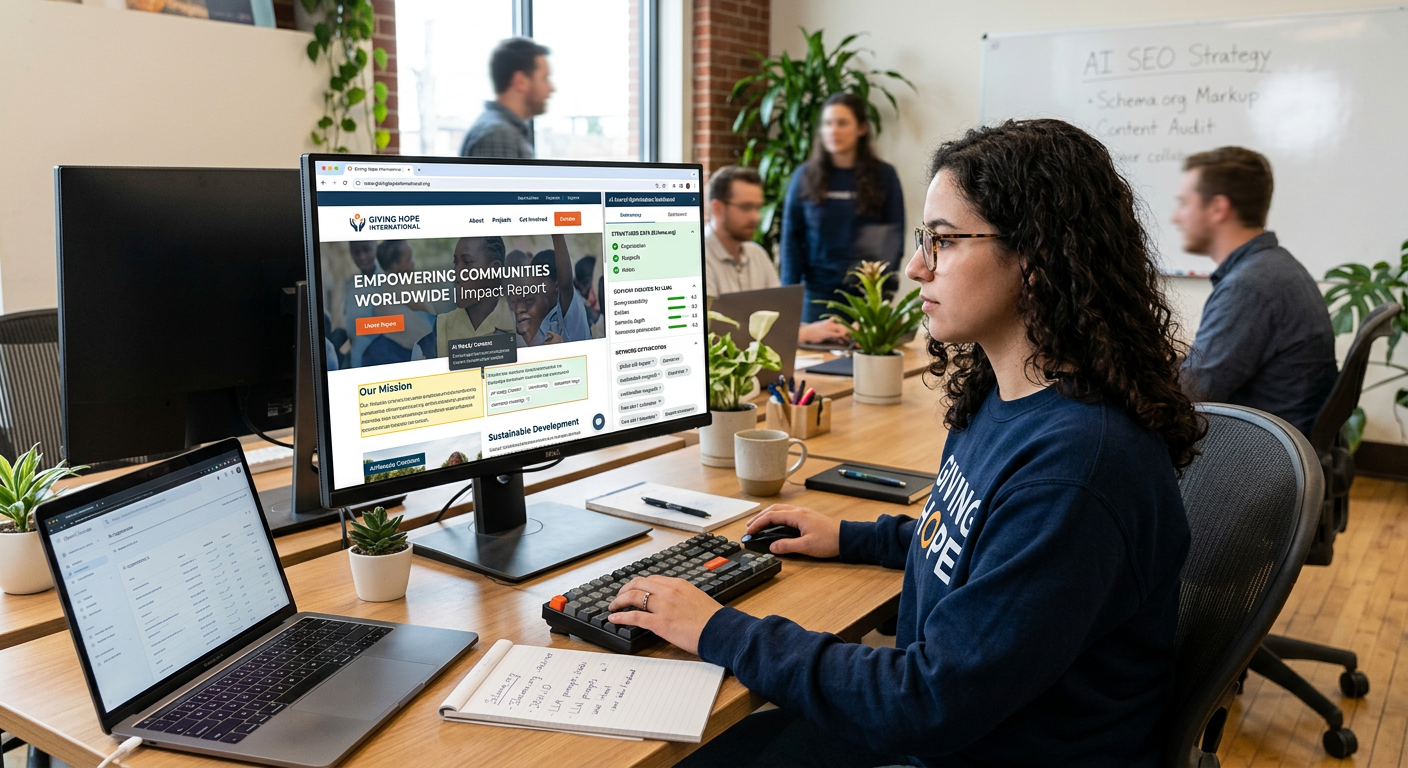
A professional working at a desk in a bright, open-concept office, focusing on a computer screen.
By EnlightWorks March 24, 2026
A comprehensive guide for non-profit leaders to transition from SEO to GEO (Generative Engine Optimization), ensuring their mission is found on ChatGPT, Claude, and Google AI.

A digital visualization of AI search engine optimization concepts.
March 19, 2026
Learn how to transition from traditional SEO to AI search optimization. Discover how to find AI-friendly topics and structure content for LLMs to gain visibility.

March 4, 2026
If you run a B2B business, your website should be your hardest-working salesperson. But for most companies, it’s not. You invest in a good-looking site, publish some content, and hope the leads come in. But they rarely do.  The reason is simple: most B2B websites are designed to look good , not to generate leads . Here are the most common problems we see: Unclear messaging: Visitors can’t tell what you do or how you help them within a few seconds of landing on your site. Poor alignment with the buying journey: B2B sales involve multiple decision-makers. Most sites don’t support this layered process. Weak calls to action: Forms are hidden, contact buttons are vague, and there’s no clear next step for the visitor. No search strategy: Your website might look professional, but if it’s not optimized for how your buyers search online, you won’t get the right traffic. No ongoing management: Websites that sit untouched quickly become outdated. B2B buyer behavior and search algorithms change constantly, and your site should evolve too.
March 4, 2026
For years, business owners have asked the same question: “Do I still need a website, or can I get by with just social media or a Google Business Profile?” In 2026, with the rise of AI-generated content, short-form social platforms, and new customer discovery tools, the question comes up even more often. But the answer hasn’t changed. Yes. You absolutely still need a website in 2026 and beyond. In fact, a professionally managed website from a provider like EnlightWorks is more essential than ever before.
March 4, 2026
Your website is a living, working asset that directly impacts your brand, conversions, and bottom line. When it is built right, optimized consistently, and managed with data-driven care, it becomes one of the most powerful investments a business can make.
March 4, 2026
If you run a Managed Service Provider (MSP) business, you’ve probably asked yourself: “Do MSPs Still Need SEO in 2026?” With AI, voice search, search engines shifting to direct answers, and new ways people consume information, some wonder if traditional search engine optimization is still worth the investment. The short answer? Absolutely, yes. SEO is not dead, but evolving. But the approach MSPs take in 2026 needs to be sharper, more strategic, and aligned with how your potential clients actually research and choose managed IT services. Let's tackle what has changed, why SEO is still essential, and how to build an MSP SEO strategy that fuels business growth, qualified leads, increases website traffic, and brand awareness in today’s landscape.
March 2, 2026
On paper, an MSP looks like any other local service business. You serve a city. You have a phone number. You want to rank on Google. But in practice, EnlightWorks MSP SEO works very differently from how SEO works for plumbers, dentists, or even other B2B service firms. If you try to run an MSP website like a generic local business, it usually stalls. Traffic stays low. Leads stay inconsistent. And the companies that do win online seem to do it without playing by the usual rules. That is not an accident. Managed IT services sit in a unique position between high trust, high risk, and long buying cycles, and that changes how search engines and buyers behave.
Show More