


The Future of SEO in an AI-Driven Search Landscape

Danny Crumpton • February 28, 2026
Digital brain with circuitry, glowing lines, and data symbols against a dark blue background.

Is SEO dead? Everyone is now saying that AI is killing Search Engine Optimization (SEO), and optimizing a website is a waste of time.


You see it everywhere. ChatGPT is now answering questions, Google is rolling out AI overviews, and suddenly, everyone is convinced that optimizing for search engines is simply useless. 


But that is not the case at all. The majority are not seeing the full picture, at least. 

SEO is far from dying. However, it is evolving into something very different. In fact, SEO is arguably more important than ever. 


How Google crawls websites has changed, and if you're still optimizing your website the way you did three years ago, you are very behind. Here is what you need to know about SEO in this AI age.

How AI has changed search

AI chatbots are now very capable of handling millions of queries—ones that people used to send to Google. 


For instance, someone types, "What's the capital of Mongolia?" and ChatGPT tells them the answer, and it’s done.


There is no search engine involved, no website visited, and no ad clicked at all. Traffic for a blog is gone.


Google's own AI overviews (formerly known as SGE, Search Generative Experience) also now sit at the top of many search results. It is synthesizing information from multiple sources and presenting it right there at the moment of the search. 


Users can get their answer instantly now without clicking through to any website. 

For publishers who've built their entire business model on Google traffic, this is genuinely and understandably terrifying. 


Why would anyone click through to your listicle about "10 Best Coffee Makers" when Google's AI already summarized all ten with pros and cons?


But here is what most people are also missing.

AI does not eliminate search, but it changes what people search for

People are still searching for things. They always are. 


Humans are curious by nature. We all still have problems to solve and want to discover products, services, and information. That natural behavior isn't magically disappearing just because AI exists.


What's changing, however, is how people search and what they're searching for.


AI can handle simple factual queries like: 


"What time does the sun set today?" 

"How do you convert cups to liters?" 

"Who won the 1998 World Cup?" 


Yes, these things can be answered by AI without anyone visiting a website.


But most valuable searches aren't simple factual queries. They're complex, nuanced, context-dependent questions where people want depth, real human perspective, trustworthiness, and multiple opinions. 


Some examples of these queries are: 


"Should I refinance my mortgage right now?”

"What's the best project management software for a remote team of fifteen people in the nonprofit sector?"

"How do I tell my boss I'm overwhelmed without seeming incompetent?"


These are not questions you can just answer right away. They require insight—more than a quick AI summary. They need expertise, experience, specific context, and trustworthy sources. And that's where SEO (evolved, adapted SEO) matters enormously now.

Google (and other search engines) still control massive traffic

Google still processes roughly 8.5 billion searches per day


Even if AI chatbots get off a chunk of that search, this is still an incomprehensible amount of search traffic.


More importantly, search traffic is what converts. 


People using search engines are actively looking for solutions. They're further along the buyer journey/consumer pipeline.


Search intent is powerful, and businesses know this. That's why Google's ad revenue is still climbing despite it all.


E-commerce isn't moving away from search at all. In fact, it's more dependent on it than ever. When someone searches for "best running shoes for plantar fasciitis," this is a consumer who is probably ready to buy. No social media platform or AI chatbot has replaced that transactional intent just yet.


B2B companies still generate the majority of their leads through organic search. Content marketing works because people search for solutions to business problems, find helpful content, and convert into leads or customers.


So, while traffic patterns might be shifting, the sheer volume and quality of search traffic mean SEO is still one of the highest-ROI marketing channels available.


Killing your SEO efforts right now because "AI is taking over" is roughly equivalent to canceling your health insurance because you feel fine today.

Why AI makes good SEO even more valuable now

This might just be the most counterintuitive part that a lot of people miss.


AI is raising the bar for content quality.


What this means is that good SEO becomes MORE valuable as a competitive advantage.

At EnlightWorks, our managed website services are built specifically for content-driven search. We have been implementing SEO strategies for years, with a focus on visibility (that converts) rather than chasing vanity metrics. 


Thin content does not win; content is still king


AI made it extremely easy to generate mediocre content at scale. For about five minutes, people thought this was great. Yes, they could pump out hundreds of blog posts with ChatGPT and dominate search results.


Except Google got wise to this immediately. Their algorithms are specifically targeting AI-generated content that's low-quality, repetitive, or adds no genuine value. The March 2024 core updates absolutely demolished websites that were gaming the system with cheap AI content.


The internet is getting flooded with garbage AI content. This means that genuinely valuable, well-researched, expertly written content stands out more than ever. 


If you're creating content that's really helpful for your target market and users, that demonstrates real expertise, that answers questions thoroughly, that builds trust… you've got a massive advantage over bulk AI-generated content. 


At EnlightWorks, content isn’t mass-produced. It’s:


  • Strategically planned
  • Written for real audiences, by real humans
  • Built around search intent
  • Structured for authority
  • Designed to convert


AI raises the bar. Strong SEO is what clears it. 


E-E-A-T matters more than ever


Google's emphasis on Experience, Expertise, Authoritativeness, and Trustworthiness (E-E-A-T) isn't going away in the AI age. It’s intensifying. When anyone can generate a convincing-sounding article about anything in thirty seconds, how does Google differentiate quality?


By looking for signals that content comes from real experts with real experience. Author credentials, brand reputation, citations from authoritative sources, user engagement signals, link profiles from respected sites—all of this matters so much more now.


If you're a doctor writing about medical conditions, a lawyer explaining legal concepts, a mechanic detailing car repairs, your expertise is your moat.


AI can generate plausible-sounding content, but it can't replicate genuine professional experience. SEO that emphasizes your actual expertise and authority becomes incredibly valuable.


AI answers still need sources


Even when AI provides an answer, it needs to cite sources. Google's AI overviews pull from websites and link to them. Perplexity shows its sources. ChatGPT's web search capability references URLs.


If your content is authoritative, comprehensive, and well-optimized, AI systems will use it as source material. 


You might not get the direct click, but you're still building brand awareness and authority. And crucially, some percentage of users DO click through to verify information or get more depth.


Being the source that AI tools cite is actually a powerful position. It's like being referenced in Wikipedia—maybe not everyone clicks through, but being the authoritative reference carries weight.

What is your website and content for?


This is where we believe many businesses are getting confused. Some are asking "is SEO worth it?" when they should be asking "What's our content strategy, and how does search fit into it?"


If your entire content strategy was built around capturing search traffic to monetize with ads, then you might not be getting ahead. 


But if your content exists to:


  • Demonstrate expertise and build trust
  • Answer customer questions and reduce support burden
  • Generate qualified leads
  • Support the buyer journey
  • Build brand awareness and authority
  • Create resources that people genuinely value


Then SEO is still incredibly valuable. Search engines (and AI systems that reference search results) are still how people discover solutions to problems. Your content needs to be discoverable, and SEO is how you make that happen.

The industries where SEO matters

Some sectors are seeing SEO become MORE critical in the AI era:


E-commerce 


Product discovery still happens through search. If anything, as Amazon becomes more saturated and social commerce fragments attention, organic search is one of the few channels where you can still reach customers with purchase intent.


Local Businesses 


"Near me" searches, local service queries, map pack results—these aren't being disrupted by AI chatbots. When someone searches "emergency plumber near me at 11 PM," they need local results, and they need them now.


Complex B2B Services


High-consideration purchases, which involve extensive research, still rely heavily on search. AI might answer surface-level questions, but serious buyers dig deeper, and that's where comprehensive, expert content captures them.


Healthcare and Legal


Regulated industries where expertise and trust are paramount. People might ask AI for general information, but when they need real advice, they search for qualified professionals.


Niche Expertise


If you're serving a specific professional or hobbyist audience with specialized knowledge, SEO helps you reach the people actively searching for exactly what you offer.

The bottom line

Is SEO worth it in the AI age? Yes. Absolutely yes. But probably not the SEO strategies known a few years ago. 


The internet isn't becoming less search-driven. Now, it's becoming more complex to determine which content deserves visibility. 


AI is accelerating the death of low-quality content while simultaneously making high-quality, authoritative content more valuable.


If you're creating genuinely helpful content, demonstrating real expertise, building topical authority, and optimizing for both human readers and machine understanding, SEO is still one of the best marketing investments you can make.


The winners in this new landscape will be the businesses that embrace SEO's evolution: creating content that's too valuable to ignore, building brands that people actively search for, demonstrating expertise that AI can't replicate, and providing depth that quick AI answers can't match.

Ready to Strengthen Your Online Authority?


If you're a B2B business or nonprofit organization looking to:


  • Increase organic traffic
  • Generate more qualified leads
  • Improve website performance
  • Adapt to AI-driven search
  • Build long-term digital authority


It’s time for a strategic partner.


Schedule your free website audit with EnlightWorks today.

A smiling person sits at a desk in an office with a laptop displaying a map and an
April 12, 2026
Let's be honest here for a second. Most MSP owners like you did not start their business because they love marketing. You started it because you are good at IT. You are an expert at it. You like solving problems, and you saw an opportunity to build something of your own. Now, you’ve got clients. That’s great! You’ve built a solid foundation. But if you want to grow (and dominate your local market) there’s one area you can’t afford to ignore: local SEO. Because right now, when a business owner in your city searches: “IT support near me” “managed IT services in [your city]” Someone is showing up on that first page of Google. And every click they get? That’s a potential client you’re not getting. The truth is, the #1 IT company in your area isn’t always the best one. It’s likely the one that shows up at the right time. So the real question here is: why shouldn’t that be you? Here is how to make that happen.

By EnlightWorks April 8, 2026
See how EnlightWorks helped Green Valley Painting grow organic traffic by 118%, rank #1 on Google for local search terms, and generate 172 qualified pricing leads from organic search alone.

Professional commercial painting crew working on an industrial building.
April 2, 2026
Learn how to transform your website into a lead machine. Discover 7 proven strategies to attract more commercial painting leads and grow your business today.
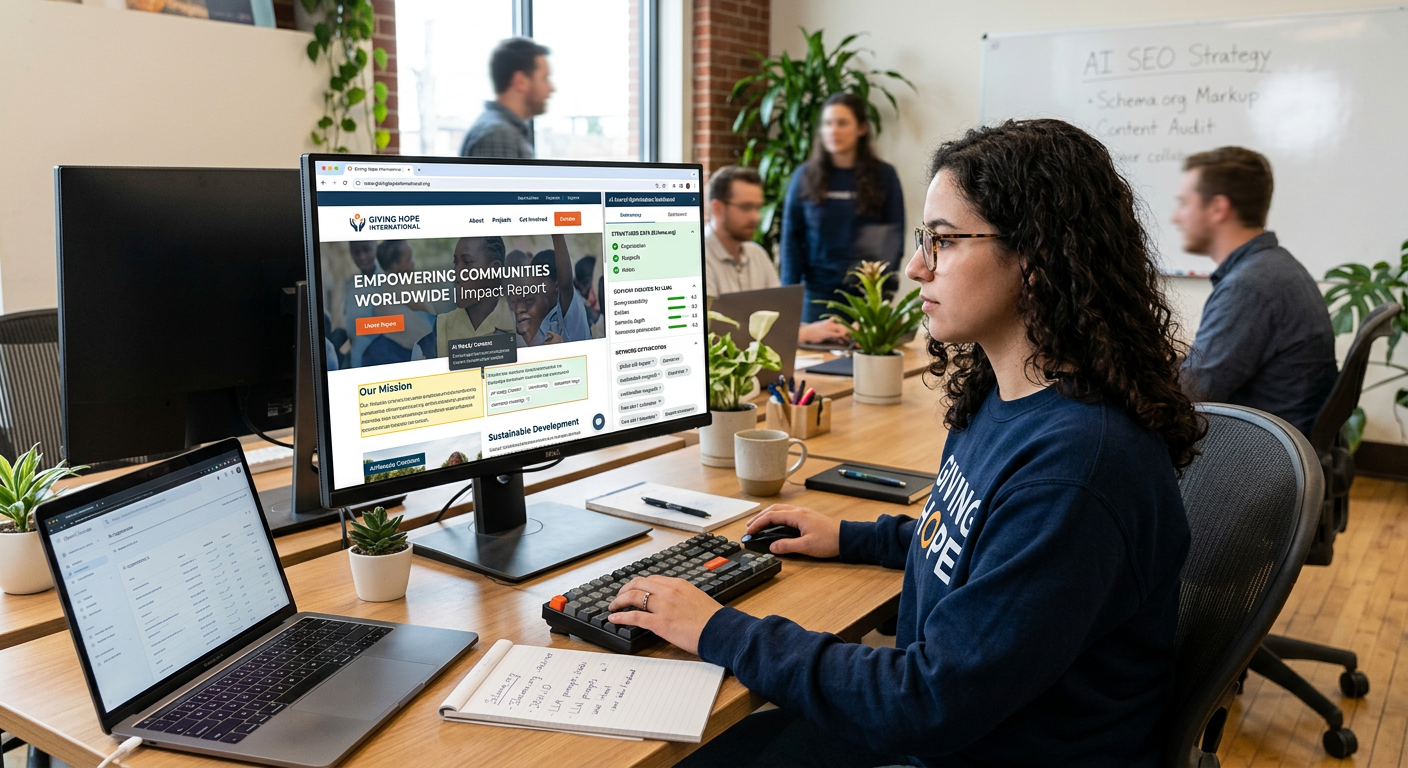
A professional working at a desk in a bright, open-concept office, focusing on a computer screen.
By EnlightWorks March 24, 2026
A comprehensive guide for non-profit leaders to transition from SEO to GEO (Generative Engine Optimization), ensuring their mission is found on ChatGPT, Claude, and Google AI.

A digital visualization of AI search engine optimization concepts.
March 19, 2026
Learn how to transition from traditional SEO to AI search optimization. Discover how to find AI-friendly topics and structure content for LLMs to gain visibility.

March 4, 2026
If you run a B2B business, your website should be your hardest-working salesperson. But for most companies, it’s not. You invest in a good-looking site, publish some content, and hope the leads come in. But they rarely do.  The reason is simple: most B2B websites are designed to look good , not to generate leads . Here are the most common problems we see: Unclear messaging: Visitors can’t tell what you do or how you help them within a few seconds of landing on your site. Poor alignment with the buying journey: B2B sales involve multiple decision-makers. Most sites don’t support this layered process. Weak calls to action: Forms are hidden, contact buttons are vague, and there’s no clear next step for the visitor. No search strategy: Your website might look professional, but if it’s not optimized for how your buyers search online, you won’t get the right traffic. No ongoing management: Websites that sit untouched quickly become outdated. B2B buyer behavior and search algorithms change constantly, and your site should evolve too.
March 4, 2026
For years, business owners have asked the same question: “Do I still need a website, or can I get by with just social media or a Google Business Profile?” In 2026, with the rise of AI-generated content, short-form social platforms, and new customer discovery tools, the question comes up even more often. But the answer hasn’t changed. Yes. You absolutely still need a website in 2026 and beyond. In fact, a professionally managed website from a provider like EnlightWorks is more essential than ever before.
March 4, 2026
Your website is a living, working asset that directly impacts your brand, conversions, and bottom line. When it is built right, optimized consistently, and managed with data-driven care, it becomes one of the most powerful investments a business can make.
March 4, 2026
If you run a Managed Service Provider (MSP) business, you’ve probably asked yourself: “Do MSPs Still Need SEO in 2026?” With AI, voice search, search engines shifting to direct answers, and new ways people consume information, some wonder if traditional search engine optimization is still worth the investment. The short answer? Absolutely, yes. SEO is not dead, but evolving. But the approach MSPs take in 2026 needs to be sharper, more strategic, and aligned with how your potential clients actually research and choose managed IT services. Let's tackle what has changed, why SEO is still essential, and how to build an MSP SEO strategy that fuels business growth, qualified leads, increases website traffic, and brand awareness in today’s landscape.
March 2, 2026
On paper, an MSP looks like any other local service business. You serve a city. You have a phone number. You want to rank on Google. But in practice, EnlightWorks MSP SEO works very differently from how SEO works for plumbers, dentists, or even other B2B service firms. If you try to run an MSP website like a generic local business, it usually stalls. Traffic stays low. Leads stay inconsistent. And the companies that do win online seem to do it without playing by the usual rules. That is not an accident. Managed IT services sit in a unique position between high trust, high risk, and long buying cycles, and that changes how search engines and buyers behave.
Show More